← Software·Case study
GetCited.
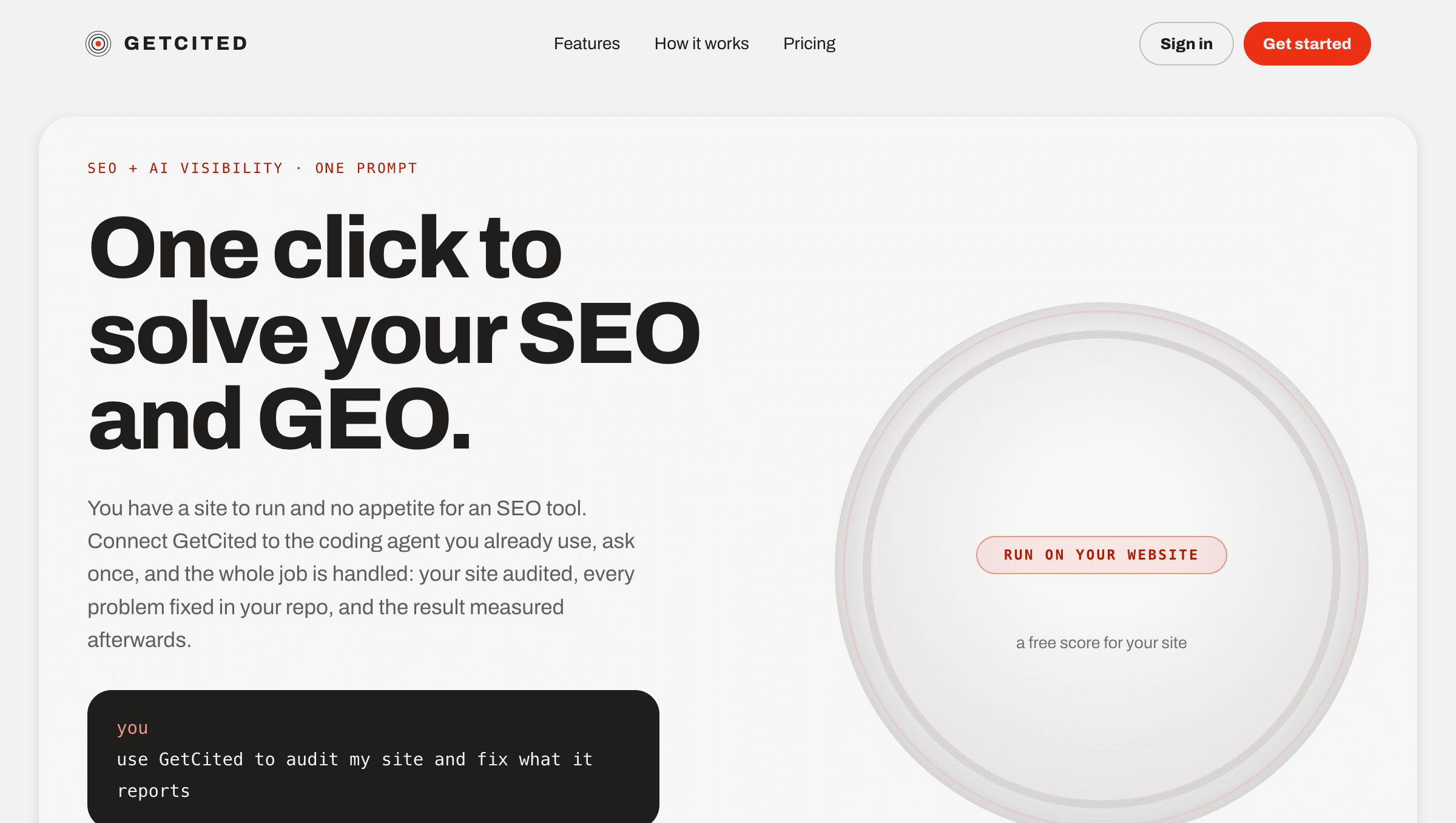
The SEO and AI-citation work that used to cost hours each week, automated inside a coding agent. Connect over MCP and it audits your site, tracks keyword ranks, records which AI engines cite you, and files each problem as an action with its evidence.
- Year
- 2026
- Role
- Founder, solo build
- Stack
- Next.js · TypeScript · Cloudflare · MCP
- Links
- Live ↗
The brief. You have three sites. Each one needs weekly rank checks, an SEO audit, and a manual test of every AI engine to see if it knows you exist. Automate all of it, permanently.
What it is
GetCited is an SEO and AI-visibility platform built as an MCP server. Connect once and a coding agent can audit any site the way an answer engine reads it, check where it ranks, measure how often ChatGPT, Perplexity, and Google AI Overviews cite it, and pull a prioritised list of what to fix next, each item with its measured evidence attached.
The agent decides the fix. The codebase is yours. The next crawl confirms whether the improvement held.
Why it exists
Running vanpeltventures.org, vanpelt.studio, and travelmaxing.app meant the same manual ritual every week.
- Rank checks 15 min
- Open a rank tracker, type each keyword, wait for the refresh, note anything that moved. Three sites, three trackers, fifteen keywords each.
- SEO audit 20 min
- Run a crawl, read the report, decide which of sixty flagged items are worth fixing. Most are not. The report does not say which.
- AI citation checks 5 min
- Open ChatGPT, open Perplexity, ask each the questions the site should answer. Write down whether the brand appears. Repeat for every engine.
The existing tools were built for SEO agencies: dashboards with team seats, weekly email digests, price tags that assume a client is footing the bill. Nothing was designed to be called by a coding agent and return a numbered list of what to fix.
Two kinds of search
Modern search means two different problems. GetCited tracks both.
Classic search
- Keyword rank: position 1 to 100 in Google results
- Search volume and difficulty, pulled for each tracked term
- AI Overview presence: whether Google answers the query itself
- Click rate when an AI Overview captures the answer instead
AI search (GEO)
- Citation rate: how often the site appears in ChatGPT, Perplexity and Google AI answers
- Measured across at least three runs per engine before a rate is reported
- Per-prompt tracking: which questions the site should answer, and does
- Signal over noise: a rate across thirty days, not a single snapshot
Built for the agent, not the dashboard
The interface is an MCP server. Any coding agent connects once and talks to it in natural language: ask for the next action and it returns the URL, the rule, the evidence. Ask whether a site is cited by an AI engine and it returns the measured rate from the last check.
The platform does not decide what to fix because it does not know the codebase. It knows the site as a reader sees it. The agent knows how to change the code. That division is the product.
How it is built
- Crawl. A server-side headless browser crawl that renders the page before reading it, so what the crawler sees is what an AI answer engine sees: rendered HTML, structured data, internal links.
- Rank. Google Search API calls, pooled and run asynchronously. Volume and difficulty land about ten minutes after keywords are added.
- GEO. Each AI engine is queried per prompt, per run, and the citation rate builds across runs. Three runs per engine before any rate is shown.
- Actions. A priority queue sorted by severity weighted by the page's own measured traffic. Pages fixed recently are held back so the same fix is not proposed twice.
- MCP interface. One connection, natural language, no dashboard required.
Status
Live, on the agency plan, and tracking three sites from day one. The same platform that filed the open issues on this portfolio is the platform this case study describes.
Want something like this built for you?